
Most companies do not have an awareness problem. They have a behaviour-change problem.
For years, cybersecurity awareness training has often been treated as an annual checkbox.
Employees receive a long e-learning course.
They click through a few slides.
They answer a short quiz.
A certificate is generated.
The company can say that training has been completed.
On paper, that may look like progress.
In practice, it is often not enough.
Because modern cyberattacks do not happen once a year. They happen every day. They arrive through emails, collaboration tools, fake login pages, QR codes, SMS messages, supplier requests, invoices, AI-generated messages and social engineering campaigns.
A single annual training session cannot keep up with that reality.
Cybersecurity awareness must move from a one-time activity to a continuous cyber awareness training behaviour programme.
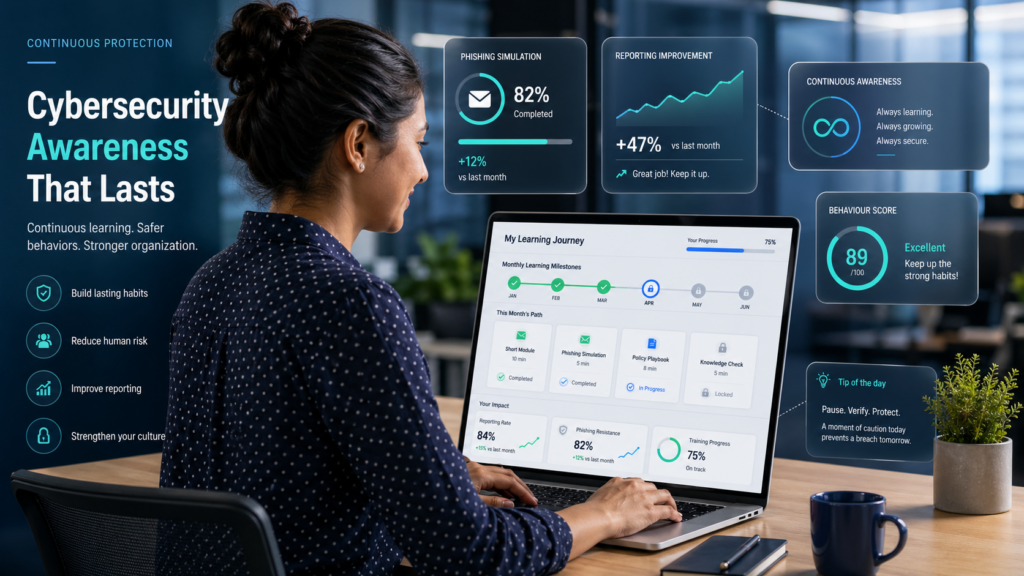
The threat landscape has changed, but training often has not
Cybercriminals no longer rely only on obvious scam emails with spelling mistakes and strange formatting.
Today, phishing and social engineering attacks are more professional, more targeted and easier to scale. Artificial intelligence has accelerated this shift.
ENISA’s 2025 threat reporting highlights artificial intelligence as a defining element of the cyber threat landscape and notes that AI-supported phishing campaigns represented more than 80% of observed social engineering activity by early 2025.
That matters for every organisation.
If attackers can create realistic, localised and personalised phishing messages at scale, employees can no longer rely on outdated warning signs such as poor grammar or suspicious-looking design.
They need to understand context, behaviour and intent.
Is the request expected?
Is the sender legitimate?
Is the urgency unusual?
Should the action be verified through another channel?
Is this a normal business process?
Should this be reported?
Traditional training often teaches employees what phishing looked like yesterday.
Modern awareness must prepare them for what phishing looks like now.
Human behaviour is still central to cyber risk
Technology is essential. Email security, endpoint protection, identity controls, MFA, backup, patching and monitoring all play a critical role.
But cyber incidents still often involve people.
The Verizon 2025 Data Breach Investigations Report analysed more than 22,000 real-world security incidents and more than 12,000 confirmed data breaches. Verizon’s SMB snapshot states that the human element in breaches remained around 60%, while third-party involvement doubled from 15% to 30%.
That does not mean employees are the problem.
It means employees are part of the attack surface — and therefore must also be part of the defence.
A company can have strong technical controls and still be exposed if employees:
- approve unexpected MFA prompts
- click convincing phishing links
- trust fake supplier emails
- fail to report suspicious messages
- reuse passwords
- send sensitive data to the wrong recipient
- respond to urgent payment requests without verification
This is why awareness cannot be limited to “information”.
It must become security behaviour.
The problem with annual awareness training
Annual training has one major weakness: it assumes that knowledge stays fresh.
But employees operate in busy, complex environments. They handle customers, invoices, meetings, deadlines, suppliers, HR tasks, management requests and daily communication across multiple channels.
Cybersecurity is rarely the only thing on their mind.
That is why long, generic training once a year often fails to create lasting behavioural change.
The typical problems are:
- the content is too generic
- the training is too long
- the timing is disconnected from real risk
- all employees receive the same material
- there is little follow-up
- results are measured by completion, not behaviour
- management gets a certificate, not a risk picture
Completion is not the same as resilience.
A company may have 98% training completion and still have employees who click phishing links, ignore warning signs or fail to report suspicious activity.
The real question is not:
“Have employees completed training?”
The real question is:
“Are employees making safer decisions in daily work?”
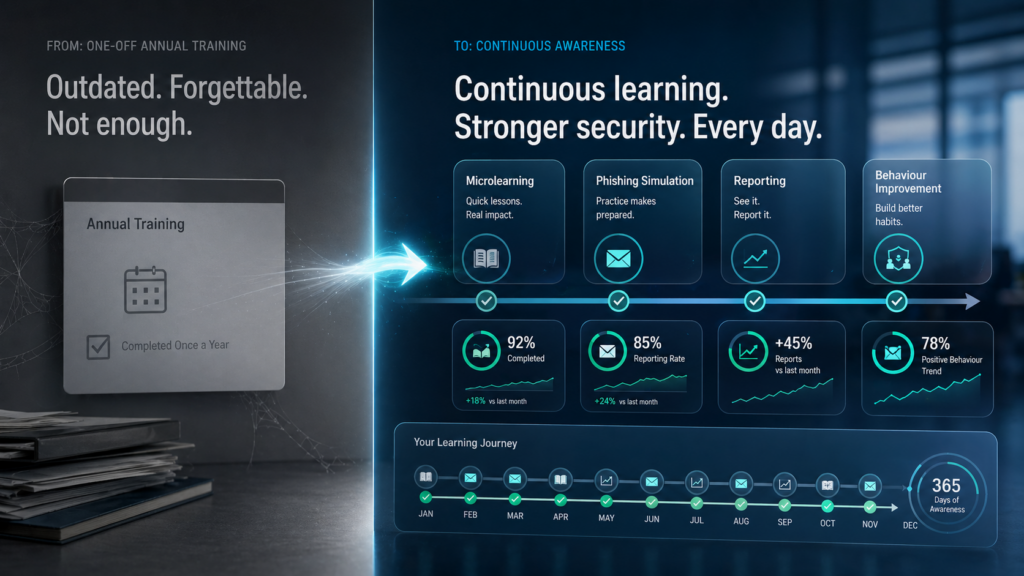
ENISA focuses on cyber hygiene and behavioural change
In Europe, cybersecurity awareness is increasingly connected to cyber hygiene and organisational resilience.
ENISA states that its awareness and cyber hygiene work is designed to promote good cybersecurity practices and foster behavioural and cultural change.
That wording is important.
Awareness is not just about sending information to employees.
It is about changing behaviour and culture.
This requires repetition, relevance, practical examples and visible follow-up. Employees must be reminded of risks in a way that connects directly to their work.
For example:
Finance teams need to recognise invoice fraud and payment manipulation.
HR teams need to understand risks around personal data and fake document requests.
Management needs to recognise CEO fraud, supplier impersonation and urgent approval scams.
IT teams need deeper technical awareness around identity, access and incident reporting.
All employees need to know how to report suspicious messages quickly.
A modern awareness programme should be role-aware, risk-aware and continuous.
NIS2 makes awareness more than a nice-to-have
NIS2 has also changed the awareness conversation in Europe.
ENISA describes NIS2 as a cornerstone of the EU’s efforts to ensure a high common level of cybersecurity across Member States.
This matters because NIS2 is not only about technical systems and legal documentation. It is about creating stronger cybersecurity practices across organisations that provide important and essential services.
Under NIS2, organisations must think more seriously about risk management, incident response, supply chain security, business continuity and cyber hygiene.
And people are involved in all of those areas.
A policy may define how incidents should be reported.
But employees need to recognise when something is suspicious.
A procedure may describe supplier verification.
But finance and operations teams need to know when a request does not feel right.
A business continuity plan may exist.
But employees need to understand their role when something happens.
NIS2 readiness therefore cannot only be built in policy documents.
It must be built into everyday behaviour.
Modern awareness must be continuous
Continuous awareness does not mean overwhelming employees with constant training.
It means creating a structured rhythm where cybersecurity becomes part of normal work.
A strong continuous awareness programme includes:
- short learning modules
- realistic phishing simulations
- role-based content
- regular reminders
- clear reporting channels
- management reporting
- targeted follow-up for exposed groups
- measurement over time
This approach is more effective because it mirrors the real threat environment.
Employees do not face cyber risk once per year.
They face it in small moments throughout the year.
A suspicious email.
A fake login page.
A strange invoice.
A QR code.
A supplier request.
A Teams message.
A password reset notification.
A document-sharing link.
Continuous awareness keeps security behaviour active.
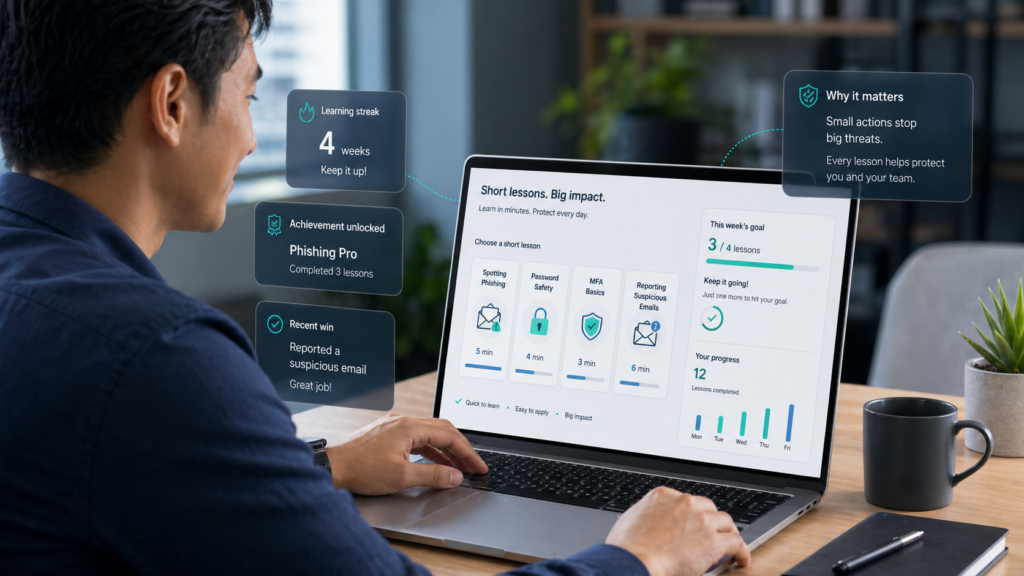
Phishing simulations turn awareness into measurable risk
One of the strongest ways to move from awareness to behaviour is phishing simulation.
Not because the goal is to “catch” employees.
The goal is to understand risk and improve behaviour.
Phishing simulations help organisations measure:
- open rates
- click rates
- credential submission attempts
- reporting rates
- department-level exposure
- improvement over time
- which scenarios are most effective
- which groups need more targeted training
This creates a much stronger foundation for management and IT teams.
Instead of saying:
“We trained everyone.”
The organisation can say:
“We know where our human risk is, we are reducing it, and we can document the progress.”
That is a completely different level of maturity.
Reporting is where awareness becomes strategic
Traditional awareness training often ends with a certificate.
Modern awareness should end with insight.
Management needs to understand where the organisation is improving and where risk still exists.
Relevant awareness reporting should show:
- training completion
- phishing click rate
- phishing reporting rate
- high-risk departments
- repeat-risk patterns
- changes over time
- campaign performance
- learning progress
- behaviour after simulations
This makes awareness valuable beyond the IT department.
For compliance teams, it supports documentation.
For leadership, it creates a risk overview.
For IT partners, it creates a better customer conversation.
For employees, it creates feedback and learning.
Awareness becomes a measurable security control instead of an isolated training activity.
One-size-fits-all training is no longer enough
A major weakness in traditional awareness programmes is that every employee receives the same content.
But not every employee faces the same risk.
A finance employee is more exposed to invoice fraud.
A CEO is more exposed to impersonation and urgent approval scams.
HR handles personal data and onboarding requests.
Sales teams communicate with many external contacts.
IT teams face privileged access and technical escalation risks.
Operations teams may deal with suppliers, logistics and physical security processes.
Training becomes more effective when it reflects these realities.
Role-based awareness does not need to be complicated.
It simply means that the content should feel relevant to the employee’s actual work.
When training feels relevant, people pay attention.
When people pay attention, behaviour changes.
Awareness should also support IT partners
For IT partners and managed service providers, continuous awareness creates a strong opportunity.
Many customers already have technical security solutions in place. They may already use Microsoft 365, endpoint protection, backup, firewalls and identity controls.
But many still lack a structured way to train employees, test behaviour and document improvement.
That gives IT partners a clear service opportunity.
Instead of only selling security tools, partners can help customers build a measurable awareness programme.
This can include:
- onboarding awareness training
- phishing simulations
- monthly or quarterly reporting
- NIS2-related awareness support
- targeted training for high-risk departments
- management reports
- improvement plans
This turns awareness into an ongoing customer relationship, not a one-time project.
It also makes cybersecurity more concrete for the customer.
They can see the risk.
They can see the improvement.
They can see the value.

CyberLearn is built for continuous awareness
CyberLearn is designed for companies and IT partners that want awareness training to be practical, measurable and ongoing.
Instead of treating cybersecurity training as a yearly checkbox, CyberLearn helps organisations build continuous security behaviour through short learning modules, realistic phishing simulations and clear reporting.
With CyberLearn, companies and IT partners can:
- deliver short and targeted awareness training
- run realistic phishing simulations
- measure employee behaviour
- identify exposed departments and groups
- follow progress over time
- document training activity
- support NIS2 and GDPR-related awareness work
- make cybersecurity easier to understand for management
- turn awareness into an ongoing service
The goal is not to scare employees.
The goal is to help them become a stronger part of the organisation’s defence.
The future of awareness is behaviour, not completion
Cybersecurity awareness has entered a new phase.
The old model was based on annual training and completion rates.
The new model must be based on continuous learning, realistic testing and measurable behaviour.
Because the threat landscape is changing too quickly for one-off training to be enough.
AI makes phishing more convincing.
Social engineering targets normal work routines.
Supply chain risk creates new exposure.
NIS2 increases expectations around cyber hygiene and resilience.
Management needs better documentation and insight.
In this environment, awareness cannot be a yearly checkbox.
It must become an ongoing security process.
A company is not truly cyber aware because employees completed a course.
A company becomes cyber aware when employees know how to act when it matters.
Ready to move beyond annual awareness training?
CyberLearn helps companies and IT partners turn cybersecurity awareness into a continuous, measurable and practical process.
With targeted learning, phishing simulations and clear reporting, CyberLearn makes it easier to reduce human risk, support compliance and build stronger security behaviour across the organisation.
Contact Cyber Detector to learn how CyberLearn can help your company or your customers move from one-off training to continuous cyber awareness.