
Modern cyberattacks rarely start with advanced hacking. They often start with a single click.
Implementing phishing awareness training can significantly reduce the risk of these attacks by educating employees on recognizing potential threats.
Most companies today have invested in technical security solutions. They use antivirus, spam filters, firewalls, Microsoft 365, backup solutions, and perhaps even advanced security policies.
And yet, phishing attacks still succeed.
Not necessarily because the technology fails, but because attackers increasingly target the most human part of the security chain: the employee.
Phishing is no longer just poorly written emails full of spelling mistakes, strange sender addresses, and obvious fake links. Today, a phishing email can look like a normal message from a bank, Microsoft, a supplier, a shipping company, HR, or even the CEO.
That is exactly why phishing remains one of the easiest and most effective ways into a business.

Phishing Has Changed
Regular phishing awareness training is essential to keep up with evolving attack strategies and to maintain a security-conscious culture within the organization.
A few years ago, phishing was often relatively easy to spot. Many attacks were poorly written, generic, and contained suspicious links.
That is no longer the reality.
Today, cybercriminals use far more convincing methods. They write professionally, tailor messages to the recipient, imitate well-known brands, and exploit normal everyday situations. It could be a fake invoice, a Microsoft login notification, a delivery update, a salary-related message, or a request from management.
Ultimately, investing in phishing awareness training is a proactive step in protecting your business from cyber threats.
With artificial intelligence, it has also become much easier for attackers to create convincing and highly targeted messages at scale.
This means companies can no longer simply teach employees to look for spelling mistakes.
They need to teach employees to understand the behaviour behind the attack.
Attackers Exploit Stress, Trust, and Routine
Phishing works because it targets people in moments where they are likely to act quickly.
An employee may be in the middle of a busy workday. An email arrives that appears to come from Microsoft, the bank, a supplier, or an internal department. The message seems relevant, and the requested action feels simple: click here, confirm your details, open the document, or log in.
The dangerous part is that phishing rarely tries to persuade the employee for a long time.
It tries to make them react quickly.
Typical phishing emails exploit:
- urgency
- authority
- fear
- curiosity
- financial pressure
- responsibility
- trust in familiar brands
That is why phishing is not only an IT problem.
It is also a psychological one.
A strong phishing email does not necessarily make the employee think:
“This is dangerous.”
It makes them think:
“I just need to take care of this quickly.”
Technology Can Stop a Lot — But Not Everything
Spam filters, email security, MFA, and endpoint protection are essential parts of a modern security strategy. But no technical solution can remove the entire risk.
Some phishing emails still get through. Some messages arrive through legitimate platforms. Some attacks begin from compromised accounts. Others happen through SMS, Teams, LinkedIn, QR codes, or fake login portals.
This does not mean the technology does not work.
It means technology alone is not enough.
Companies need to combine technical security controls with employees who are trained to recognise suspicious messages, pause before acting, and respond correctly when something feels wrong.
The Biggest Mistake Is Assuming Employees “Should Know Better”
When an employee clicks on a phishing email, it is rarely because they do not care about security.
It often happens because the message fits into a normal work situation.
A finance employee receives an invoice.
An HR employee receives a document containing personal data.
A manager receives a login notification.
A new employee gets a message about setting up access.
A busy employee receives what looks like a Teams notification.
This is exactly why generic awareness training is no longer enough.
If every employee receives the same annual e-learning course, but real phishing attacks are targeted and realistic, there is a gap between training and reality.
Employees need to be trained for the situations they actually face.
Awareness Training Must Be Continuous, Short, and Relevant
Effective awareness is not about sending employees through a long course once a year.
It is about building continuous security behaviour.
The best training is short, practical, and relevant. Employees need to understand what to look for, why it matters, and what to do when they are unsure.
This can include short learning modules about:
- phishing
- passwords
- MFA
- fake login pages
- social engineering
- CEO fraud
- data sharing
- use of AI
- handling personal data
- reporting suspicious messages
When awareness training is combined with realistic phishing simulations, the company gets a much clearer picture of its real risk.
Because it is one thing to ask employees whether they can recognise phishing.
Read about DBIR rapport
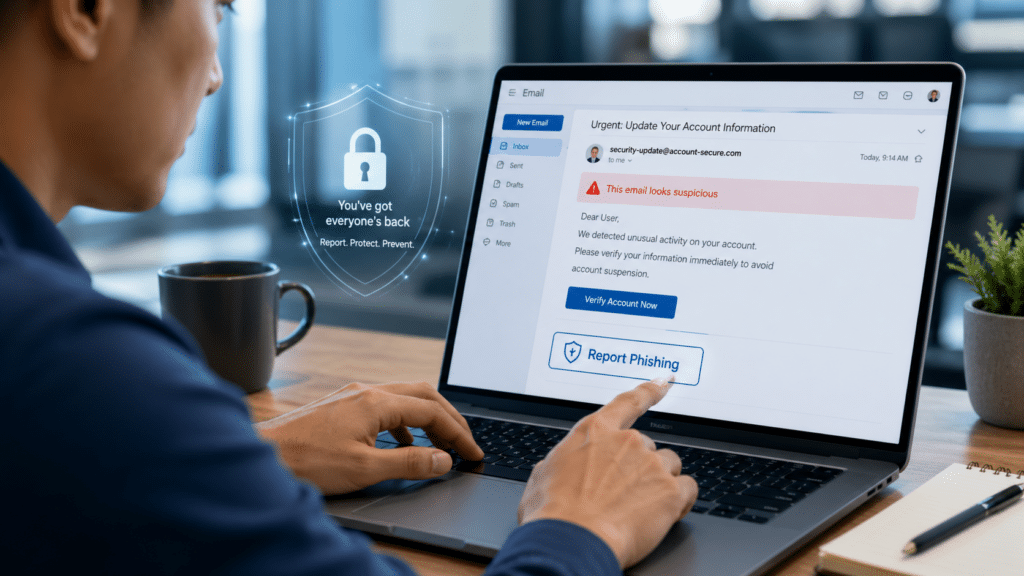
The Importance of Phishing Awareness Training
It is something completely different to test it in practice.
Phishing Simulations Give Management a Clear Risk Picture
One of the biggest advantages of phishing simulations is that they make risk measurable.
Instead of guessing the company’s security maturity, you can see:
- how many employees open phishing emails
- how many click
- how many attempt to log in
- which departments are most exposed
- which phishing methods work best
- whether training improves behaviour over time
This makes cybersecurity more concrete for management, IT, and compliance teams.
For IT partners, it also creates a strong opportunity to have a more valuable conversation with customers. Instead of only talking about products, licences, and technical solutions, the partner can show the customer a real picture of employee security behaviour.
This turns phishing training into more than education.
It becomes a decision-making tool.
Phishing Is Also a Compliance Issue
For many companies, cybersecurity is no longer only a technical responsibility. It is also a management responsibility.
With requirements from frameworks and regulations such as NIS2, GDPR, and increasing expectations from customers, suppliers, and partners, documentation is becoming more important.
Companies must increasingly be able to show that they are actively working with cybersecurity. Not only through policies and technical controls, but also through training, follow-up, and continuous improvement.
Awareness training and phishing simulations can therefore play an important role in a company’s overall security work.
Not as a replacement for technical solutions.
But as the layer that helps employees become an active part of the defence.
A Modern Security Strategy Must Include People
Cyberattacks are becoming more advanced, but the goal is often still the same:
To get a person to do something.
Click a link.
Open a file.
Enter login credentials.
Approve an action.
Transfer money.
Share information.
That is why employees should not be seen as the weakest link.
They should be seen as an important security layer.
But this requires the right training, the right tools, and the right understanding.
When employees learn to pause, recognise warning signs, and report suspicious messages, they become an active part of the company’s cyber defence.
CyberLearn Makes Phishing and Awareness Practical
At Cyber Detector, we developed CyberLearn for companies and IT partners that want a more practical and measurable approach to awareness training and phishing simulations.
CyberLearn combines short learning modules, realistic phishing simulations, and reporting, allowing companies to work continuously with employee security behaviour.
The platform makes it easy to:
- run phishing tests
- target training to employees and departments
- track progress over time
- document awareness efforts
- give management a clear overview
- help IT partners deliver awareness as an ongoing service
For companies, it is about reducing risk.
For IT partners, it is about helping customers with a concrete, relevant, and value-creating cybersecurity service.
Are Your Employees Ready for the Next Phishing Email?
Phishing is not going away.
On the contrary, attacks are becoming more convincing, more targeted, and easier to scale.
That is why the question should not be whether a company will be targeted by phishing.
The question should be:
How will employees react when it happens?
With CyberLearn, companies and IT partners can test, train, and document employee resilience against phishing and social engineering.
Would you like to see how resilient your company or your customers are?
Contact Cyber Detector for a non-binding conversation about CyberLearn and a 14-day phishing and awareness test.